Security Guide: Why Legacy Microsoft Works Conversion Should Stay Offline
For security, compliance, and IT-governance teams approving conversion tools.
TL;DR
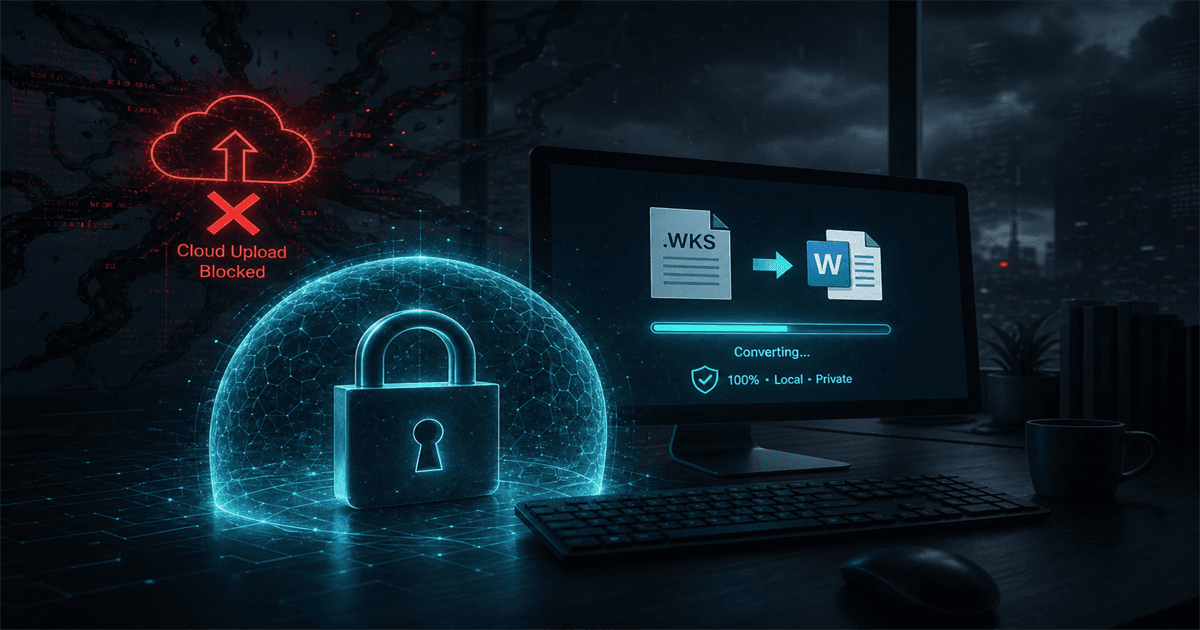
Free online Microsoft Works converters are convenient and dangerous. They can expose payroll, pricing, customer, and operational data to unknown servers and retention policies. A local desktop converter, paired with a documented workflow and per-file conversion log, is the conservative default for any organization that takes data residency seriously.
The legacy spreadsheet exposure problem
Legacy Microsoft Works files are unusually rich in sensitive data. Payroll, pricing, customer lists, engineering assumptions, internal forecasts, and historical financials all show up in 1990s spreadsheets because that is what those tools were used for.
The path of least resistance is also the worst path: someone searches for "free Microsoft Works converter," uploads the file, and the data is now on a third-party server with unknown retention.
Where the risk really lives
1. Data residency and retention
Most free converters say "files are deleted after one hour" without explaining where the file traveled or what was logged. Auditors and customers care about both.
2. Vendor due diligence
Online converters rarely meet the standard internal-vendor due-diligence checklist used for any other SaaS. They are quietly used outside the procurement process, then discovered during an unrelated audit.
3. Confidentiality obligations
NDAs, customer agreements, and regulatory frameworks (HIPAA, GDPR, GLBA, SOX, FERC, PCI) often forbid uploading covered data to unmanaged third parties. A free converter rarely fits.
A defensible offline workflow
Convert from a read-only copy of the archive on a workstation that meets the organization's standard endpoint baseline. Write the outputs to a separate, access-controlled folder, and capture a per-file conversion log with source path, output path, format, and timestamp.
Treat the original Microsoft Works file binaries as evidence. Keep them in a separate retention-managed location until policy says otherwise.
A short security checklist
- Use a tool that runs entirely on the workstation, with no cloud upload step.
- Mount the source archive read-only and convert into a separate output folder.
- Capture a per-file conversion log (source, output, format, timestamp).
- Sample-test the output before deleting or relocating originals.
- Document the workflow in the data-handling policy so it is repeatable during audits.
Why Works File Converter is the safe default
- 100% local: files never leave the workstation, the firm network, or the regulated environment.
- Bulk-friendly: drag a folder, choose XLSX/PDF/CSV/HTML/Markdown/XLS, and process everything in one pass.
- Mirror folder structure: outputs land in a clean, predictable layout that maps to the original archive.
- One-time license: no monthly subscription, no telemetry contract to negotiate with security.
Put offline conversion in policy, not in inboxes
A "do not upload spreadsheets to random websites" memo is necessary but not sufficient. Pair it with an approved local tool and a documented workflow so teams have somewhere safe to do the work that needs to happen anyway.
Related reading
Make local Microsoft Works conversion the approved default
Trial Microsoft Works File Converter on a sample archive and confirm the local workflow meets your security baseline before rolling it out across the organization.
Free trial
Full app features - up to 10 files
Windows 10 or 11
Download the offline installer below for the full 10-file trial. Conversion stays on your PC.